
European CPG brands are still asking the wrong question of their technology: "What happened?"
When the digital shelf was new, visibility into product pages, search rankings, and reviews was enough. But today's marketplaces have become too algorithmic for brands to spend their time identifying issues, deciding on a resolution, and manually executing it.
The last thing today's brands need is another reporting tool that points to what went wrong. In CommerceIQ's 2026 AI Retail Survey Report, 46% of ecommerce leaders said their data is not actionable, while 40% said there is simply too much of it to process. Brands need technology that can identify an issue and recommend a resolution automatically and in real time.
Where reporting tools fall short
Reporting tools identify problems, but they do not resolve them. A dashboard flags an issue, then the brand or an agency investigates it, decides on a fix, and implements the change. While this model is familiar, with 76% of commerce teams still relying on agency support, it is too slow to keep up with today's marketplaces.
Brands need AI agents to take on execution while internal teams and agencies shift their focus to strategy and oversight. That preserves human control: 43% of commerce leaders say keeping a human in the loop is non-negotiable.
Reporting identifies issues but cannot fix them
When a dashboard flags a problem, it gets passed to a team that could be managing thousands of SKUs manually. Meanwhile, marketplaces such as Amazon continuously evaluate inventory availability, price, seller standing, and shipping speed to determine which brand wins the Buy Box. A competitor that acts faster can take it and capture sales before the brand has time to react.
Most SKUs go unchecked
Brands have traditionally followed the 80/20 rule, prioritising top performers while the rest of the catalogue receives far less attention. Those unchecked listings slowly become outdated and lose share of search, a trade-off brands have been willing to accept.
AI makes it possible to optimise every listing at scale, and brands that do are already improving visibility and capturing sales beyond their best sellers. A single overlooked SKU may have little impact on its own, but across thousands of products and multiple marketplaces, those missed opportunities compound.
How brands are using AI to execute on the shelf
Brands are changing what they expect of their technology. Instead of a record of what happened, they need the ability to identify a problem and execute a fix immediately. With agentic retail, an AI agent does the work a dashboard could only report on, while team members approve the action it suggests.
Keeping every listing current
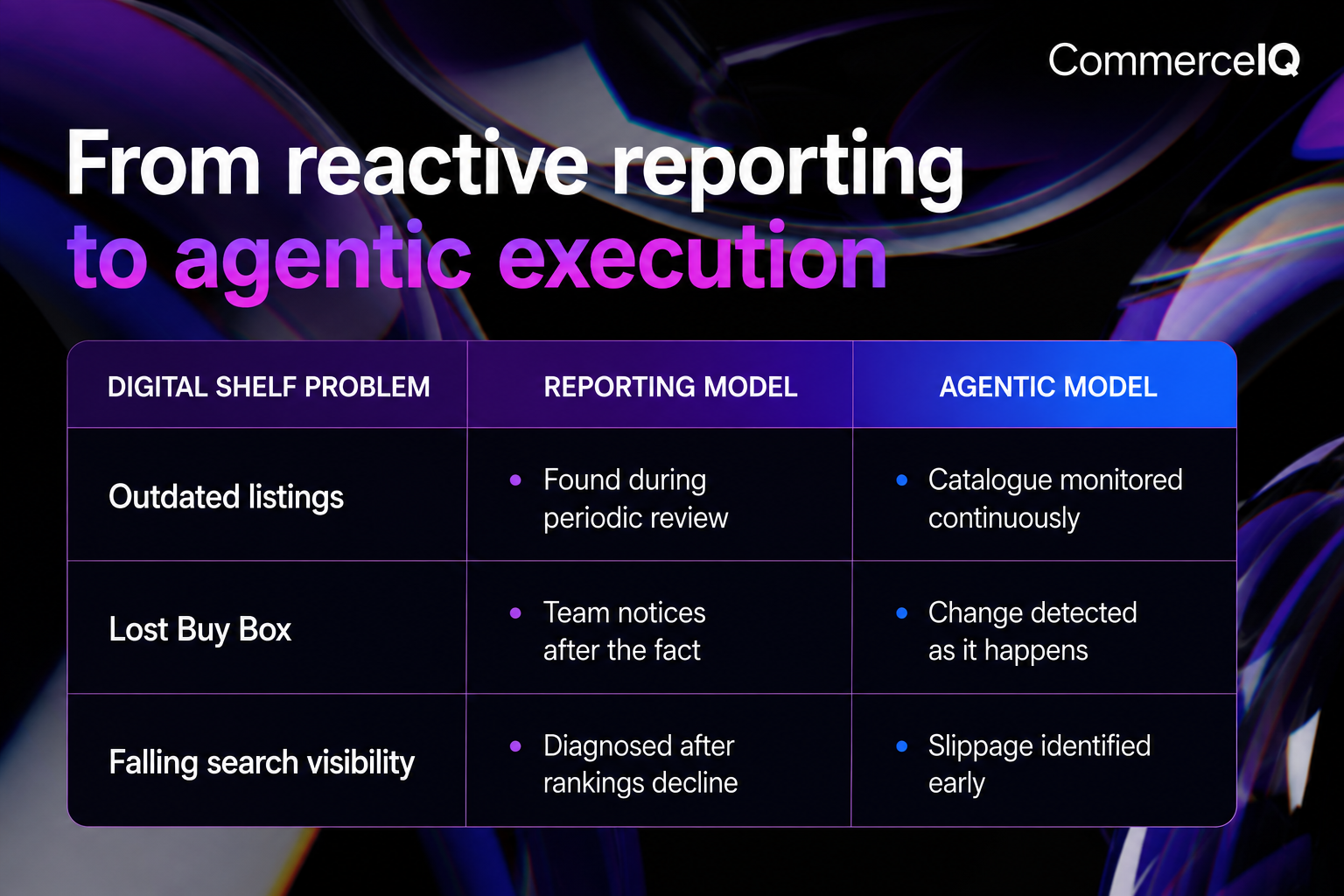
Brands have traditionally focused on the top 20% of listings, while the rest of the catalogue received less frequent attention and could become outdated between content refreshes. An AI agent can review all product pages, identify content that is no longer current, and generate recommendations at scale, leaving team members to approve or decline the suggestions.
Defending the Buy Box in real time
Brands tend to monitor Buy Box performance at set intervals, creating a lag between when a competitor can win the Buy Box and when the team notices. Because eligibility can change frequently based on inventory, price, seller standing, and shipping speed, even a short delay can cost sales. An AI agent can monitor those signals continuously, flagging a vulnerable or lost Buy Box as soon as it happens and recommending the appropriate response in real time.
Recovering share of search
Losing share of search has often happened gradually, so brands may see the impact in sales before pinpointing declining visibility as the cause. Diagnosing the problem means comparing individual listings against the search terms shoppers use and identifying where products have slipped in rankings. An AI agent can make that comparison continuously across the entire catalogue, flagging listings that are slipping out of sight so brands can optimise them before the decline results in lost sales.
Brands asking the right question are winning share
A shelf tool that can only report on what it sees, rather than act on it, is the status quo—and that status quo will carry an ever-increasing tax. As leading brands recognise that data and dashboards are no longer enough, they will gain an advantage by moving to agentic capabilities. They can empower teams to drive sales rather than manage dashboards.
Brands that shift from asking "What happened?" to "How do we fix it in real time?" are the ones winning share. As marketplaces continue to move faster, brands using an agentic retail platform such as CommerceIQ can operate at the speed of today's marketplaces.
Request a demo